🎧 Prefer to listen? Play the audio version below:
About this episode:
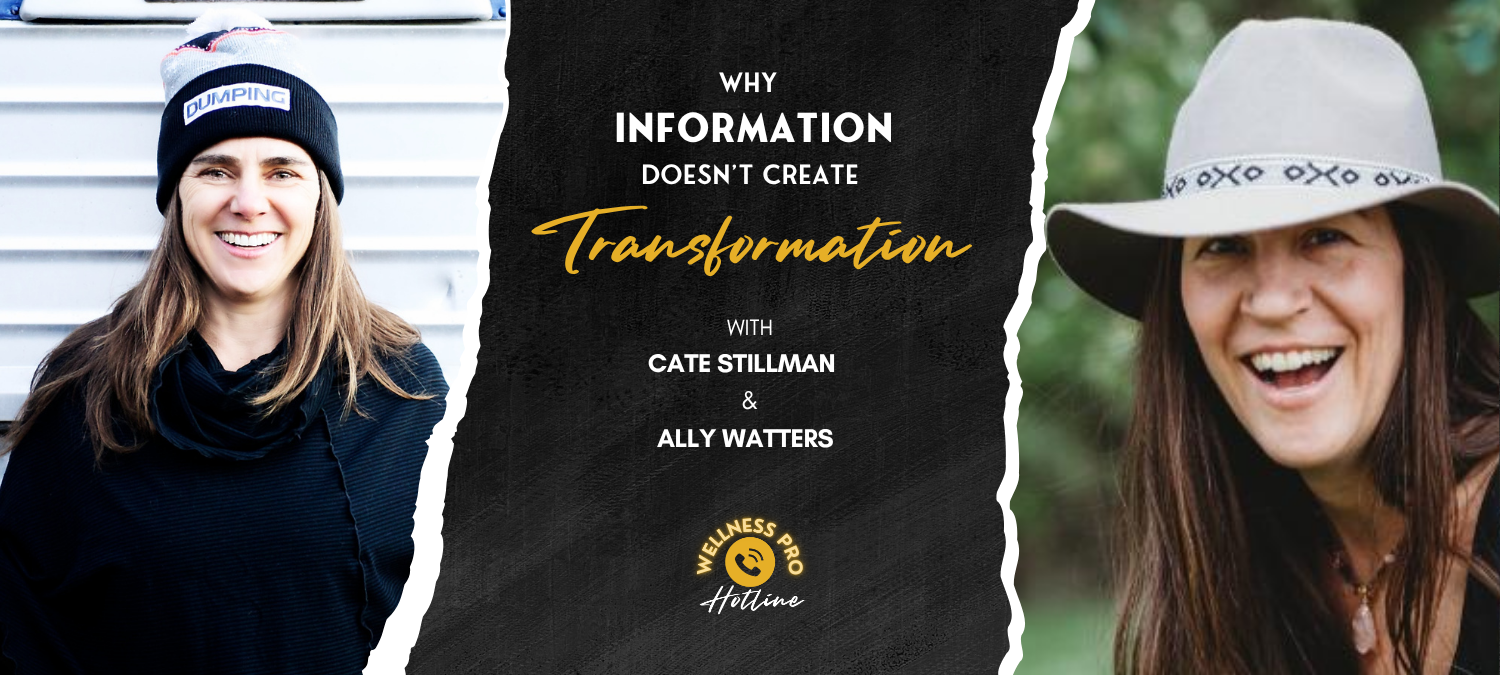
In this candid Wellness Pro Hotline session, Cate Stillman sits down with Ally Watters — Wellness Pro Academy member, longtime bodyworker, and founder of Thrive Mode — for a real-time coaching session on the two hardest transitions most wellness pros face: migrating platforms and repositioning their business identity.
Ally has been running her coaching offer on Hey Marvelous for years alongside a busy bodywork practice, weekly Thursday group calls, and email campaigns in MailChimp. The engagement she wants is there in her live sessions, but not in the forum — because her current platform simply doesn't foster it. As she considers migrating to SKOOL, she's also facing a bigger identity shift: moving from "bodyworker who coaches on the side" to "coach who does bodywork on the side."
Cate walks her through both moves in real time — including how to migrate without rebuilding everything, why community engagement is the true multiplier of member success, and how to reposition existing clients into the new structure without losing them.
This is a working example of what a Wellness Pro Hotline session actually looks like — no theory, no fluff, just direct coaching on the exact obstacles wellness pros hit as they scale from transactional to transformational.
What You'll Learn in This Episode
- Why "Personal Netflix" learning platforms are quietly dying — and what to move to instead
- The 80/20 rule for content migration when you have years of assets built up
- Why community engagement (not learning) is the true make-or-break metric for wellness clubs
- How to reposition existing clients into a coaching container without them feeling upsold
- Why manual onboarding beats fancy automations at small scale
- The 20-member business model reframe that changes every tech decision you make
- Low-cost incentives that shift member behavior into your new platform fast
The Real Problem Wasn't the Platform. It Was the Attention.
Ally didn't come to the call looking to migrate platforms.
She came looking for permission to delay the migration until fall — after her next detox cycle — so she could focus on building her AI chatbots first. It was a smart-sounding, phased approach.
Cate cut through it immediately:
"I'm such a rip-off-the-bandaid kind of gal. What can happen is we can build it into this bigger thing when really it could be either handing it over to a VA on Fiverr to move the top 20 in just 80/20 it."
The real problem Ally was solving wasn't tech logistics. It was engagement.
Her weekly Thursday group calls were rich, authentic, and full of the kind of member support she wanted more of. But her forum? Silent. Yours truly included, as she put it. And the reason wasn't lack of will — it was too many clicks to get there. The platform architecture killed the behavior she wanted.
Every day she stayed on the old platform was a day her members' engagement decayed a little more.
Why "Personal Netflix" LMS Tools Are Quietly Dying
What Cate names next is one of the most important observations in the whole episode.
For the past decade, tech-savvy wellness pros built the equivalent of their own personal Netflix — a library of courses, cleanses, challenges, and content hosted on whichever LMS was popular that year. Kajabi. Teachable. Thinkific. Hey Marvelous. Podia. The list is long.
But something has quietly shifted underneath all of them:
"Not all platforms were created equal. A lot of them had decent streaming or decent scheduling, but had low engagement. That's a war for attention. And a lot of it depends on platform funding and how well these platforms are able to attract other users onto them."
The math is brutal: LMS tools that aren't investing in engagement features right now are losing market share. And when platforms lose market share, they stop building. And when they stop building, your members' experience quietly degrades.
Cate has lived this personally. She once tanked her own email list revenue by staying too long on a well-loved but underfunded tool. The lesson stuck: the platform your business runs on isn't just a tool — it's a bet on where the audience is going.
Why SKOOL Won This Round
Cate is unusually bullish on SKOOL for wellness pros, and the reasons are specific:
- Cost is nominal ($100/year range) — but that's not the primary reason
- The engineering behind it is phenomenal — well-funded, well-developed, actively investing in features
- Forum-first UX — opens directly to the community thread, not a course dashboard
- DMs, leaderboards, polls, and shoutouts are all built in and easy to use
- Everything happens inside one platform — no more juggling email, community, and course delivery across three tools
Ally's own reason for looking at SKOOL was equally specific:
"Money is not part of my decision process. It's $125 a month. It's nothing. I'm just saying what I want is higher engagement. Because I have a good amount of people who show up for the weekly call. The conversations that are happening there, the authenticity, the support — that's what I want to amplify. And the only way to do that is with a community forum."
She had already diagnosed the problem correctly. She just needed permission to move now instead of later.
The 80/20 Migration Rule
One of the biggest blockers Ally named was the sheer scope of what she'd built over the years — the branding, the thumbnails, the payment plans, the email campaigns, the classroom structures. Moving all of it felt like a full-time job.
Cate's reframe:
"You don't look at the whole 'you need to move 100% of Netflix over.' You just start with 80/20. What is the 20% of stuff living in your own personal Netflix library that people actually use? Just 80/20 that."
For Ally, that meant:
- Move the current active offer (spring cleanse, gut microbiome challenge)
- Skip the content that current members weren't even using
- Rebuild only the classrooms new members will actually need
- Hire someone on Fiverr for the pure data-migration grunt work
- Personally focus only on the strategic reshuffling — the parts requiring judgment
The whole migration collapses from "months-long project" to "a few weekends of intentional work."
The 20-Member Reframe That Changes Everything
Halfway through the session, Cate names the mental model most wellness pros are running on — and why it's silently causing them to overbuild.
"So much of us, our mindset is built on 300 customers, but rarely do we have 300 customers. Like we usually have 20 to — in Wellness Pro Academy, 15 to 35. That's more or less the range for most of the wellness pros. So it doesn't need to be that fancy."
Once Ally reframed her target as 20 committed members rather than a mass-scale audience, every downstream tech decision got simpler:
- She doesn't need Zapier automations
- She doesn't need complex Stripe integrations
- She doesn't need a marketing funnel
- She doesn't need to fully replicate her Hey Marvelous payment plan architecture
A 10-minute manual onboarding checklist works better than a broken automation. And enrolling 2 members per month means she has plenty of time to onboard each one personally — which is exactly the touch her ideal clients want anyway.
"There's ways to do it fancy with automations. But honestly with enrolling two people a month for a process, it's going to take you 10 minutes to make sure you do it right."
The Bigger Repositioning: From Bodyworker to Coach
Halfway through the session, Ally names the identity shift underneath all the tech decisions:
"Part of it too is just shifting my mindset away from 'I'm a bodyworker who has a coaching business on the side' to 'I have a coaching business, and I have bodywork on the side.' That's what I realized the other day is more important to me — to think of it in those terms."
This is the shift most wellness pros eventually face. The service they built the business on becomes the anchor that keeps the business small. The service they know will actually create transformation becomes the thing they treat as optional.
Cate's coaching on the repositioning:
- Change the button — literally and metaphorically
- Reframe every conversation with existing clients through their desired result, not your business needs
- Position the coaching container as the reason bodywork will actually stick
- Move bodywork to a bookable service inside the coaching offer — not the main offer
"You can still have me like this in person, but you have to be in my coaching program. This is why — because health is diet and lifestyle based. I can't help you change your habits unless you're in the coaching program."
Community Is the Health Intervention
Toward the end of the session, Cate names what makes this whole model work — and why lone-wolf clients almost always regress.
"A lot of people are trying to change their health in a vacuum, and they have no accountability. Their partner isn't into health the way they're into health. They think they're doing everything and they're not. There's no accountability built in. So the community kind of gives up on them. That's the piece that's missing."
Ally names it back:
"You can feel a sense of doing it when you know other people are also struggling standing in their kitchen, standing in their bathroom, standing in the grocery store aisle and struggling. Like, okay, we're all in this together."
This isn't just a marketing message. It's the actual health intervention. Which is why the community platform decision isn't really about tech — it's about whether your members get well.
The 10-Minute Daily Community Habit
Once you're on the right platform, the last piece is the daily rhythm. Cate shares her own — and the aspirational version she's building toward:
- Check DMs a few times a day (naturally, without effort)
- Reply to member questions within 24 hours
- Post a shoutout: "Live coaching, shoutout to Julie — she showed up on SKOOL, she's engaged, she's posted, she's asking questions"
- Run a poll: "Are you dealing more with gut health or trauma right now?"
- Incentivize migration behavior with low-cost gifts ($10 at Whole Foods, an "ace in the pocket" 20-min call)
Total time: about 10 minutes a day. Total impact: exponential.
Why This Matters Now
The wellness pros who make the platform migration and the repositioning shift in the next 12 months will be the ones running high-engagement, high-renewal clubs by 2027. The ones who delay will find themselves increasingly isolated on legacy platforms with quiet forums, disengaged members, and rising churn.
Neither move requires perfection.
Both moves require ripping off the bandaid.
Resources & Links
🌐 Thrive Mode — Ally Watters' Coaching Program
🌿 Wellness Pro Academy → wellnesspro.academy
🧘 Yogahealer → yogahealer.com
Books by Cate Stillman:
- 📗 Body Thrive → https://amzn.to/3udNFR0
- 📘 Master of You → https://amzn.to/3OlfoGn
- 📙 Primal Habits → https://amzn.to/3OvfPOx
- 📕 Uninflamed → https://amzn.to/3UUBgJ2
Referenced in this episode:
- SKOOL (community platform)
- Hey Marvelous (legacy LMS reference)
- MailChimp + Stripe integrations
- Alex Hormozi teachings