🎧 Prefer to listen? Play the audio version below:
About this episode:
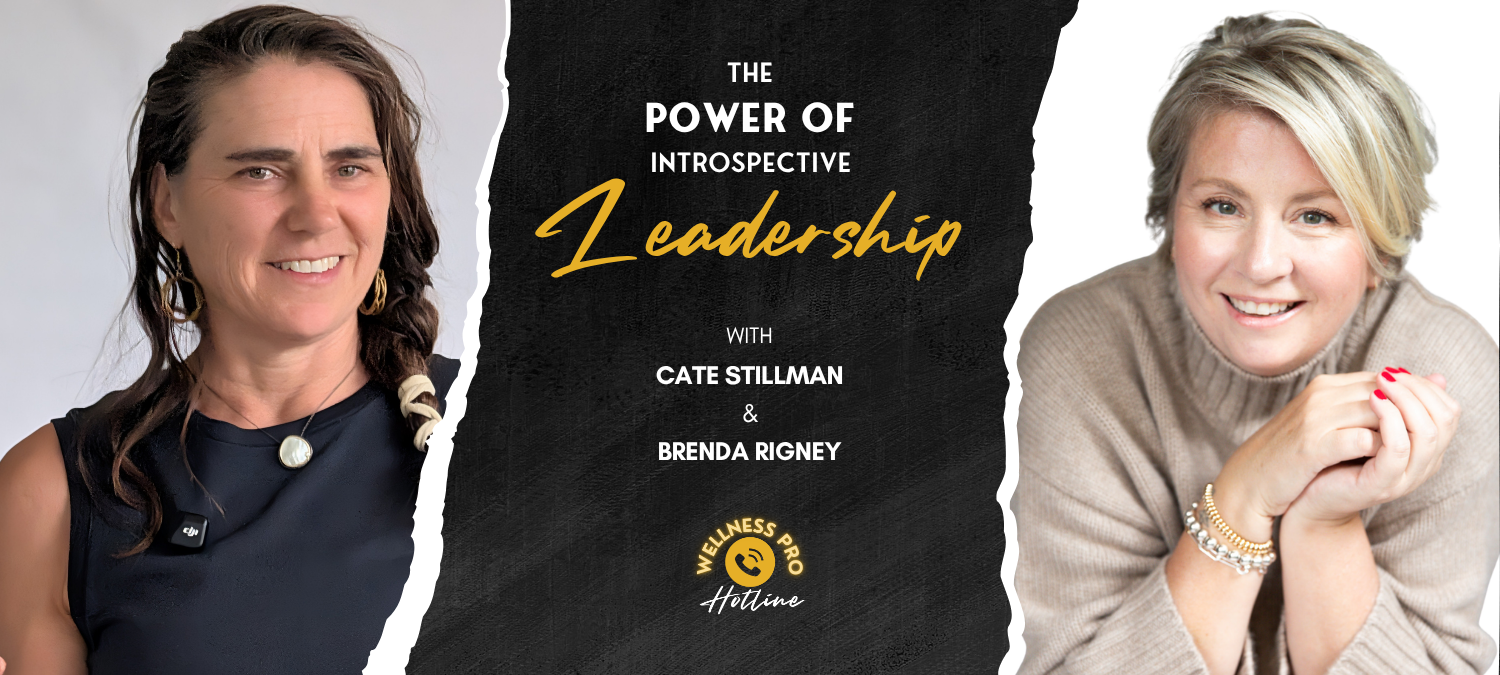
In this candid Wellness Pro Show episode, Cate Stillman sits down with Brenda Rigney — former COO of an $80M business turned company-of-one entrepreneur, founder of SKOOL Scale Camp, and one of the most successful summit hosts on the SKOOL platform — for a deep-dive conversation on how to build a genuinely location-independent business without losing revenue or engagement.
Brenda walked away from a corporate role trending toward a $500K solo business to intentionally rebuild everything around a different question: What if my business revolved around my life instead of my life revolving around my business?
The answer became SKOOL Scale Camp — a freemium community that has grown to over 13,000 members across two brands, generates $55K summits in 2 months, and runs entirely from wherever Brenda happens to be in the world (currently Northern France, previously Spain, next stop London).
Cate mirrors the parallel arc from her own 25-year online business journey. Together, they unpack what has genuinely shifted for wellness pros and online entrepreneurs, and where the leverage now lives.
This is a working example of what location-independent business actually looks like from two women who've done it, at different scales, with completely different offer stacks.
What You'll Learn in This Episode
- Why "personal Netflix" LMS platforms are quietly dying — and what to move to instead
- How to use a summit as your primary traffic engine
- The three revenue streams inside a freemium community
- Why onboarding beats course creation for member engagement
- How to build an AI + one human team stack that runs from anywhere
- The "2% of the cake" rule for what belongs in free vs. paid tiers
- How the leaderboard becomes a conversion diagnostic (not just gamification)
- Why $9 offers to a warm community of 13,000 can generate $5,000 in a single day
From $80M COO to Company of One
Brenda Rigney's path to location independence didn't start with a laptop on a beach.
It started at the top of a corporate ladder — as Chief Operating Officer of an $80M business — where she'd built a career around scaling operations, teams, and systems. When her twin daughters graduated from high school and immediately moved east for university, she recognized what many mid-career women eventually see: the reason she'd been anchored to Vancouver was no longer there.
Her business at the time was trending toward $500K annually — running masterminds, high-ticket coaching, and consulting for enterprise-level clients. Most of it was face-to-face or hybrid, tied to her physical location. And she was standing at a fork in the road:
Give up the business she'd built, or rebuild it to fit the life she actually wanted.
"I was just like, do I want this? Do I need this? So I looked at making some adjustments and moved over to this membership-based model."
The pivot wasn't graceful. In her first attempt on SKOOL in April 2024, she looked around at what she called "the bro marketing" — rip-your-tank-top, Grand Theft Auto energy — and left. What is this? I'm out.
She came back later that year when SKOOL started diversifying, and the timing became her advantage. By April 2025, she had made the full commitment to a freemium community model. By November 2025, she'd built a business generating $55K in two months of summits — while running the business from Europe.
Why "Personal Netflix" LMS Platforms Are Quietly Dying
One of the most important observations in the entire conversation comes early:
"Not all platforms were created equal. A lot of them had decent streaming or decent scheduling, but had low engagement. That's a war for attention. And a lot of it depends on platform funding and how well these platforms are able to attract other users."
For the past decade, tech-savvy wellness pros and coaches built the equivalent of their own personal Netflix — libraries of courses, cleanses, challenges, and masterminds hosted on whichever LMS was popular that year. Kajabi. Teachable. Thinkific. Hey Marvelous. Podia. Mighty Networks.
Every one of these has quietly lost market share to platforms actively investing in engagement features — most notably SKOOL.
Cate has lived this personally. She once tanked her own email list revenue by staying too long on a well-loved but underfunded tool.
The lesson stuck: the platform your business runs on isn't just a tool. It's a bet on where the audience is going.
The Summit as Traffic Engine
The single biggest leverage point Brenda has unlocked on SKOOL is the summit.
Her first summit — June 2025, with speakers drawn from her existing 75-member community — brought in 950 people over three days with almost no ad spend.
Her October and November 2025 summits combined brought in 9,000 members and $55,000 in revenue.
The three revenue streams she runs through each summit:
- Sponsored speaker slots ($150-$575 per slot for live sessions with prime placement)
- All-Access Speaker Pass sales (typically $29, but she can sell 150-250 of these per summit)
- Premium and VIP membership upgrades triggered by the exposure of the summit
The math is remarkable: a $10,000 sponsorship budget covers her Meta ad spend, which drives the summit growth, which grows the community, which increases sponsorship demand for the next summit. It compounds.
"I literally just post it up in my community and people buy the sponsorships because they see a community where we have constant traffic. They see that I'm making money."
Why SKOOL Won This Round
Both women are unusually bullish on SKOOL for community-driven business owners, and their reasons are specific:
- Cost is nominal ($100-125/month range) — but that's not the primary reason
- The engineering behind it is phenomenal — well-funded, well-developed, actively investing in features
- Forum-first UX — opens directly to the community thread, not a course dashboard
- Growth Boost initiative — SKOOL actively sends organic traffic to growing communities
- Everything happens inside one platform — no more juggling email, community, and course delivery
- Affiliate structure is built in — no ThriveCart, no manual payouts
Brenda adds concrete proof:
"Every time I grow by a dollar or add a person in my community, it gets SKOOL looking at my community and I get more people. In the last couple of days, I've added close to 50 members into SKOOL Scale Camp — and SKOOL sent me about half of that on top."
The Freemium Design Rule: 2% of the Cake
The single most common mistake Brenda audits inside her VIP members' communities:
Giving away too much for free.
"How much free stuff do you have? Number one, they could all be either turned on by all the free stuff and just consume it for days. Or the free stuff is overwhelming them and they're like, 'If I'm overwhelmed by the free stuff, what's going to happen when I upgrade?'"
Her rule for freemium design is deceptively simple:
- Design premium lightly — sketch out what you want premium to be
- Give a sliver of that — literally 2% — inside the free community
- Position it as: "You like this first layer of cake? Great. Did you know there's a second layer and a third layer?"
The temptation to over-give in free will always kill the upgrade path. Restraint at the free tier is what makes premium worth the ask.
Onboarding Over Courses
The other big engagement mistake wellness pros make? Creating more and more content.
"Stop that now. Everything's free on YouTube. AI can replicate it in five seconds or less."
What actually drives engagement isn't more content. It's a solid onboarding experience:
- A 3-5 day challenge that members complete inside the community
- Something they do and then post about on the community board
- A win that reinforces they're now part of a group, not just consuming a course
- Leverage of the built-in SKOOL leaderboard — with points awarded for community-strengthening behaviors
Brenda's insight on the leaderboard is worth pausing on:
"If they are moving up the leaderboard, those are behaviors of conversion. They are interested in progressing and doing something. The people that don't move up the leaderboard, you're probably not going to be able to monetize."
Gamification isn't about competition. It's a diagnostic for who's ready to buy.
The AI + One Human Team Stack
One of the most tactical parts of the conversation is Brenda's actual team breakdown — a genuine company-of-one at scale.
Her one human: A longtime creative director she worked with in her corporate days. He does 10-15 hours a month on integration work — Zapier setups, Meta pixel fixes, email platform migrations, tech implementations. The stuff that requires human judgment on infrastructure.
Her AI team:
- Content agents in Claude — podcast, YouTube, community lives, all editing and repurposing
- Image generation — Claude, ChatGPT, and Gamma depending on the need
- Emily the growth strategist — a real human who runs engagement strategy in her communities, moving members from level to level on the leaderboard
The key insight: as her communities grew past 13,000 members, the work shifted from getting more people in to nurturing the ones already there. Emily runs that layer.
"Similar to your email list — you can pile in more people, or nurture the people you've got in there. So I'm now growing my team looking at how we can get people from level one to level two, and these people at level three who haven't moved to level four."
Volume vs. High-Ticket: Two Legitimate Paths
One of the most refreshing parts of the conversation is where Cate and Brenda diverge without either being wrong.
Brenda's model: Volume + low-ticket + freemium funnel. A $9 offer sold to 13,000 warm members can generate $5,000 in a single day. She sells All-Access Speaker Passes at $29 and makes $5,000 in three days. She doesn't want to be locked into long-term client commitments — she wants to jump on a plane whenever she pleases.
Cate's model: Small + high-ticket + deep transformation. Wellness Pro Academy members typically run clubs of 15-35 members at $2,500-$15,000 annually. Deep work, small audiences, high conversion, transformational outcomes.
"I just want to be making money on SKOOL every day. I can literally get on a plane this morning and get off of it tonight and make a thousand dollars. That's fine for me. I used to be in the world where I'd be hustling for that one $15,000 offer, and I'd be locked in."
Both models work. Both are legitimate. The right one for any wellness pro depends on whether their zone of genius is span (marketing skill, community management, digital fluency) or depth (transformational healing work, one-to-one guidance, deep expertise).
What Has Actually Changed in 25 Years
Toward the end of the episode, Cate offers a rare perspective — she's been building online businesses since 2001 and has watched what actually works survive multiple platform generations.
What has consistently worked for two and a half decades:
- Content marketing
- Email list growth and nurturance
- High-ticket sales on the phone
- Partnership marketing and list exchanges
What has changed dramatically in the last 18 months:
- The role of the VA has been largely absorbed by Claude
- Content creation cost has collapsed 90%+
- Small businesses can now compete on production quality that used to require agencies
- Community platforms have become the primary battleground for attention
- Location independence has become genuinely accessible, not aspirational
"If you think it's hard now, it's easier than it's ever been. There's always going to be some component of what the work is. With your business model, that really defines what the work is. And then AI can help you do the work."
Why This Matters Now
The wellness pros, coaches, and mid-career women entrepreneurs who move now — while SKOOL is investing heavily in growth boost, while AI teams are becoming standard, while location independence is genuinely accessible — will be the ones running sustainable, joy-filled businesses by 2027.
Those who wait for permission, for perfection, or for the next platform will be perpetually rebuilding on ground that keeps shifting.
Neither Brenda's model nor Cate's model requires you to be someone you're not.
Both require you to stop building a business you resent and start building one that fits the life you actually want.
Resources & Links
🌐 Brenda Rigney's Website → brendarigney.com
🎓 SKOOL Scale Camp (Brenda's free community)
🌿 Wellness Pro Academy → wellnesspro.academy
🧘 Yogahealer → yogahealer.com
Books by Cate Stillman:
- 📗 Body Thrive → https://amzn.to/3udNFR0
- 📘 Master of You → https://amzn.to/3OlfoGn
- 📙 Primal Habits → https://amzn.to/3OvfPOx
- 📕 Uninflamed → https://amzn.to/3UUBgJ2
Referenced in this episode:
- SKOOL (community platform)
- Sam Ovens (SKOOL founder)
- Alex Hormozi teachings
- Claude AI (Brenda's primary content team)
- Canva, Meta Ads, MailChimp, Stripe integrations
- Gamma (for visual content generation)